Instructions
THIS IS A PRACTICE EXAM ONLY, THE GRADE YOU GET FOR THIS EXAM IS NOT USED IN YOUR FINAL GRADE CALCULATION FOR THIS COURSE.
This mock exam will help you understand the difficulty you can expect on the real final exam.
Exam Rules
- The exam will be available for two hours on 06.05.2025@14.15 - 16.15 in L6.
- The exam is in person and proctored.
- Only the exam screen may be open during the exam -- no textbook, no notes, no phones, no AI tools, no internet resources allowed.
- If you are found engaging in any unapproved behavior, your exam will be immediately terminated.
- You must bring your own laptop to the exam. Without a laptop, you will not be able to complete the exam.
Good luck!
1. Classes, struct, constructors
Question 1
What is the result of compiling and executing the following code?
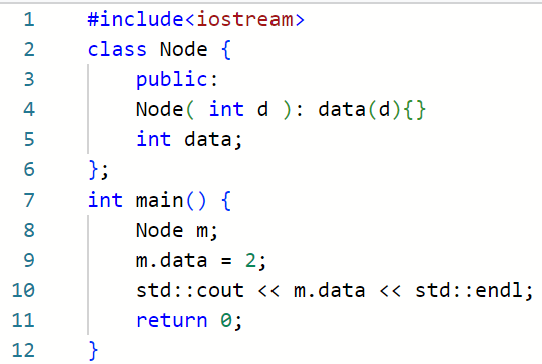
A.
B. The code results in a compile error.
C. The code results in a runtime error.
D. The code has undefined behavior.
E. None of the above describes the execution of this function.
2 sent to standard out.B. The code results in a compile error.
C. The code results in a runtime error.
D. The code has undefined behavior.
E. None of the above describes the execution of this function.
Question 2
Consider the following class
Gadget and its use in the client main() function: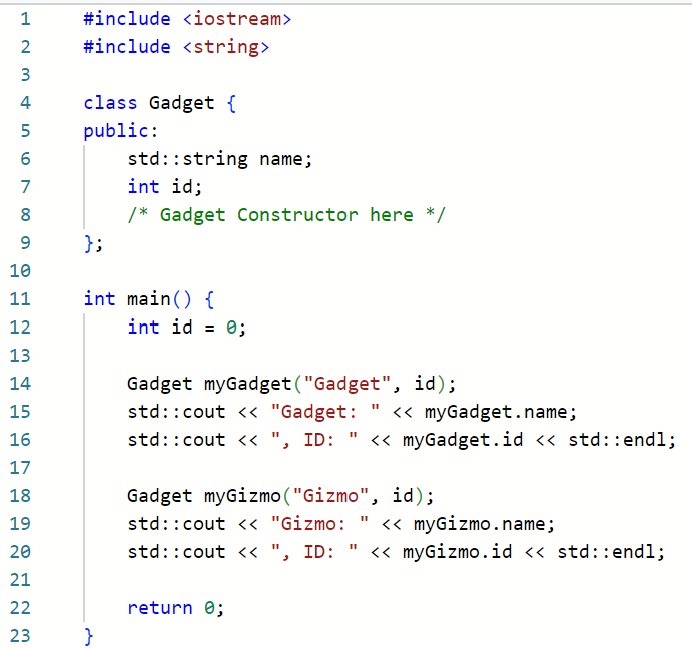
What should the constructor for the class
Gadget for the code to compile and run with no warnings, producing the following standard out output?Gadget: Gadget, ID: 1 Gizmo: Gizmo, ID: 2
A.
B.
C.
D.
E. None of the above
Gadget(std::string n, int i) : name(n), id(++i) {} B.
Gadget(std::string n, int &i) : name(n), id(i++) {} C.
Gadget(std::string n, int i) : name(n), id(i++) {} D.
Gadget(std::string n, int &i) : name(n), id(++i) {} E. None of the above
2. .cpp/.h, encapsulation
Question 3
Consider the following code:
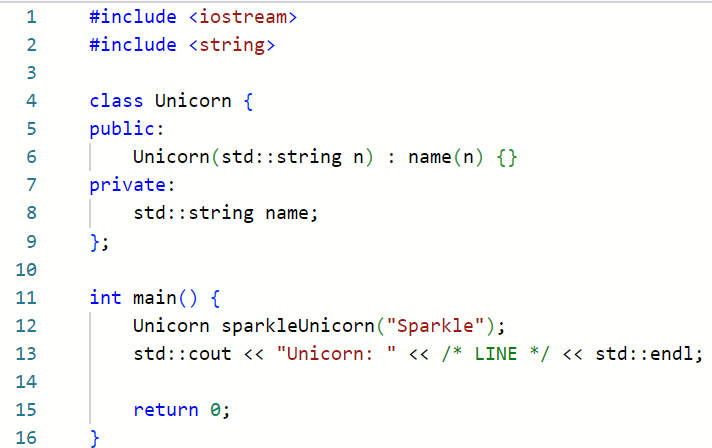
Which of the following should replace
/* LINE */ so that the code compiles and runs with no warnings and with Unicorn: Sparkle sent to standard out? A.
B.
C.
D.
E. None of the above.
sparkleUnicorn.name B.
sparkleUnicorn->name C.
Unicorn.getName() D.
Unicorn->name E. None of the above.
Question 4
Consider the following code:
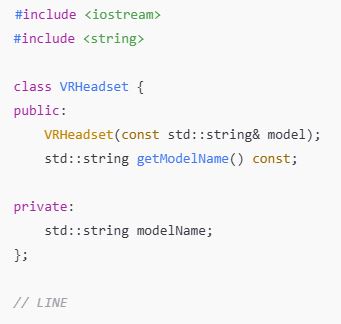
Which of the following is the correct function definition for the member function
getModelName outside of the VRHeadset class in place of // LINE?A.
std::string getModelName() const { return modelName; } B.
std::string VRHeadset::getModelName() const { return modelName; } C.
std::string VRHeadset::getModelName() { return modelName; } D.
std::string VRHeadset::getModelName(std::string model) const { return modelName; } E.
std::string getModelName(std::string model) const { return modelName; } 3. Makefiles
4. Variables, memory, pointers, scope resolution
Question 8
What is the result of compiling and executing the following code?
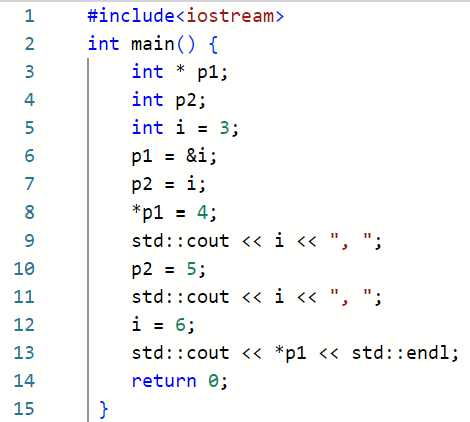
A.
B.
C.
D. This code results in a compile error.
E. This code results in a runtime error
4, 5, 6 sent to standard out. B.
4, 4, 6 sent to standard out. C.
3, 3, 4 sent to standard out. D. This code results in a compile error.
E. This code results in a runtime error
Question 9
Consider the following code:
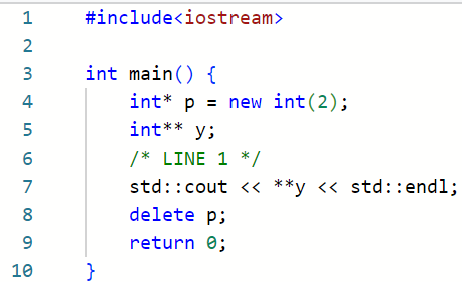
Which of the following should replace
/* LINE 1 */ so that the code compiles and runs with no warnings and with 2 sent to standard out? A.
B.
C.
D.
E.
*y = &p; B.
*y = p; C.
**y = *p; D.
y = *p; E.
y = &p; Question 10
What is the result of compiling and running the following code?
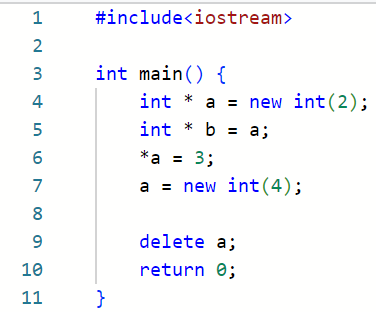
A. The program incorrectly uses the
B. The pointer
C. The program outputs incorrect values due to improper initialization of the pointers.
D. The value assigned to
E. Memory allocated to pointer
F. There is a double deletion error when
delete operator, causing undefined behavior.B. The pointer
b is reassigned, causing the initial memory allocation to be lost without being freed.C. The program outputs incorrect values due to improper initialization of the pointers.
D. The value assigned to
b is never used before reassignment, suggesting redundant code.E. Memory allocated to pointer
a in line 4 is never released, leading to a memory leak.F. There is a double deletion error when
delete b is called.Question 11
UPDATE: Everyone got full points for this question.
The
swap function does not work as expected. How should it be modified to correctly swap the values pointed to by a and b? 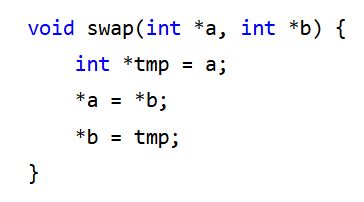
A. Replace
B. Replace
C. Replace
D. Replace
E. The pointers
int *tmp = a; with int tmp = *a;B. Replace
*b = *tmp; with *b = *a;C. Replace
int *tmp = a; with int tmp = b;D. Replace
*b = *tmp; with *b = tmp;E. The pointers
a and b should be passed by reference instead of by value: void swap(int *& a, int *& b) {...} 5. Stack Heaps Arrays
Question 12
Consider the following code:
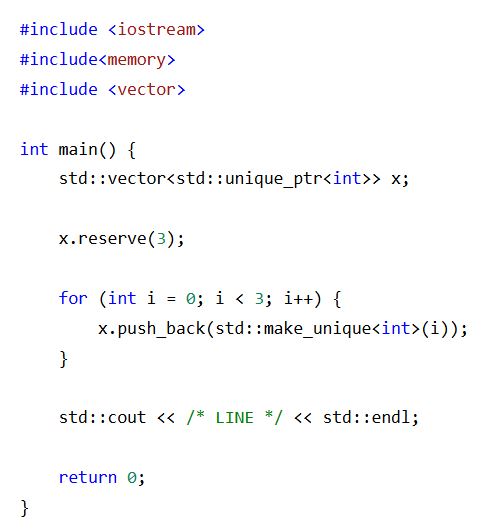
Which of the following should replace
/* LINE */ so that the code compiles and runs with no warnings and with 1, 2 sent to standard out? A.
B.
C.
D.
E. None of the above.
x[1] << ", " << x[2] B.
(*x)[1] << ", " << (*x)[2] C.
*x[1] << ", " << *x[2] D.
**x[1] << ", " << **x[2] E. None of the above.
Question 13
Consider the following incomplete code:
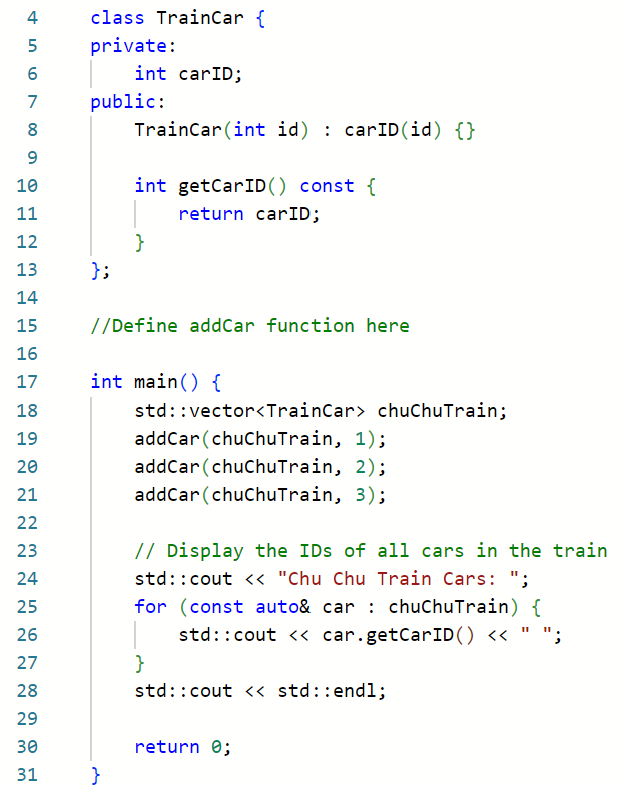
Your task is to complete the
addCar function to add a new car with the given carID to the chuChuTrain vector. Ensure that the new car is added to the end of the chuChuTrain. A.
int addCar(std::vector<TrainCar> train, int carID) {
    train.push_back(TrainCar(carID));
    return carID;
}
B.
void addCar(std::vector<TrainCar>& train, int carID) {
    train.push_back(&TrainCar(carID));
}
C.
void addCar(std::vector<TrainCar> train, int carID) {
    train.push_back(TrainCar(carID));
}
D.
void addCar(std::vector<TrainCar>& train, int carID) {
    train.push_back(TrainCar(carID));
}
E. None of the above
6. ASAN, Valgrind
Question 14
Update: Both D and A were accepted.
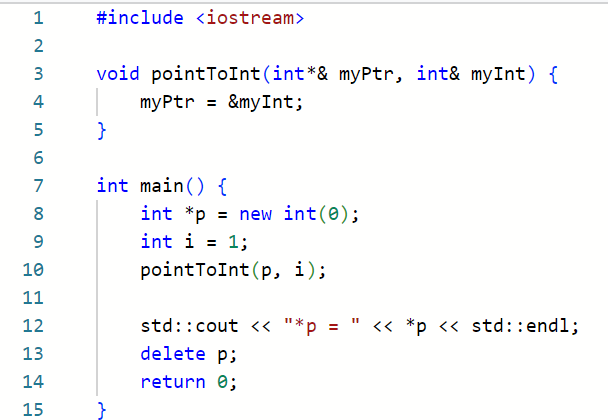
Consider the following code in program1.cpp:
and program2.cpp:
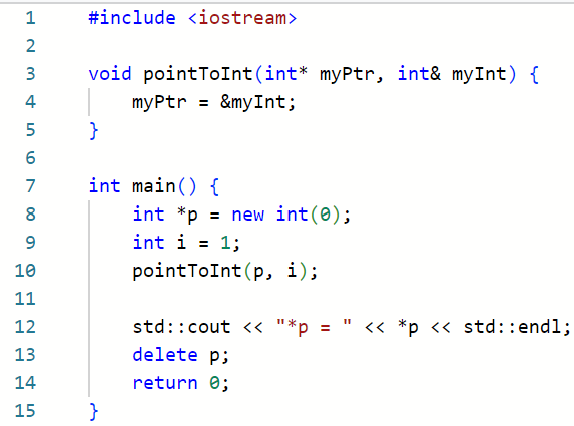
Which one of the two programs has a runtime error, with the following message from ASAN:
==1==ERROR: AddressSanitizer: stack-use-after-return on address 0x799061e00060
at pc 0x00000040143e bp 0x7fffa727cbf0 sp 0x7fffa727cbe8
A. Only 1.
B. Only 2.
C. Both 1 and 2.
D. Neither 1 nor 2.
B. Only 2.
C. Both 1 and 2.
D. Neither 1 nor 2.
Question 15
This program contains a significant error. If compiled and run with an address sanitizing tool like ASAN or Valgrind, what kind of error could it report?
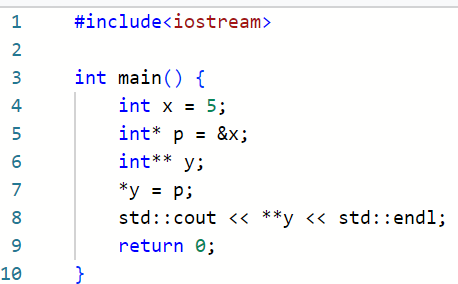
A. Buffer overflow error.
B. Memory leak detection.
C. Use of an uninitialized pointer.
D. None of the above would be detected by an address sanitizing tool.
E. All of the above.
B. Memory leak detection.
C. Use of an uninitialized pointer.
D. None of the above would be detected by an address sanitizing tool.
E. All of the above.
Question 16
This program contains a significant error. If compiled and run with ASAN, what kind of error would it most likely report?
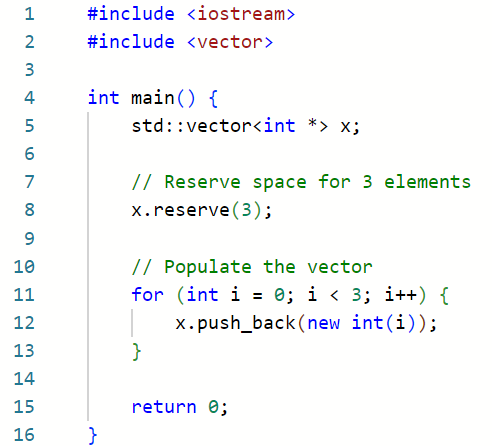
A.
B.
C.
D.
E.
F. None of the above
==1==ERROR: AddressSanitizer: heap-buffer-overflow on addressB.
==1==ERROR: AddressSanitizer: detected use of uninitialized valueC.
==1==ERROR: AddressSanitizer: attempting double-free on addressD.
==1==ERROR: UndefinedBehaviorSanitizer: undefined behaviorE.
==1==ERROR: LeakSanitizer: detected memory leaksF. None of the above
7. Parameter passing, return, const
Question 17
Consider the following code:
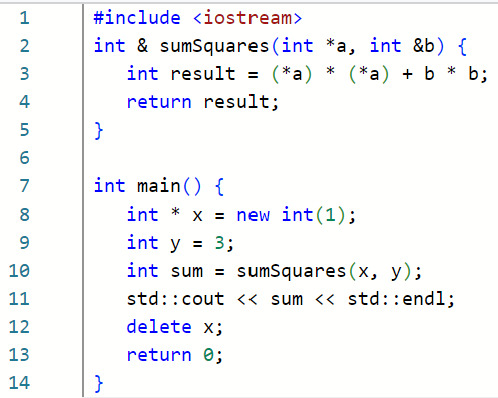
Which one of the following best describes the result of compiling and executing the above code?
A.
B.
C.
D. The code has undefined behavior because
E. None of the above.
4 sent to standard out. B.
7 sent to standard out. C.
8 sent to standard out. D. The code has undefined behavior because
result goes out of scope. E. None of the above.
Question 18
What is the result of compiling and executing the following code?
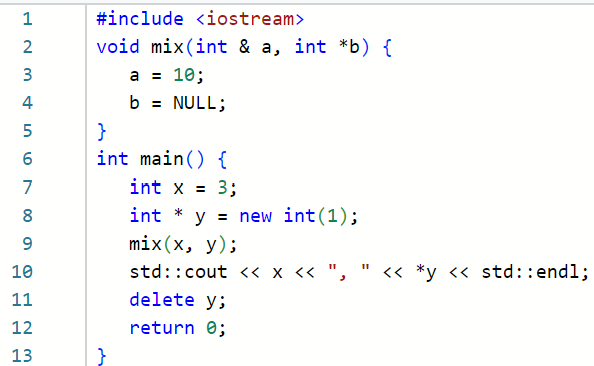
A.
B.
C. The code does not compile.
D. The code results in a runtime error.
E. None of the above.
3, 1 sent to standard out. B.
10, 1 sent to standard out. C. The code does not compile.
D. The code results in a runtime error.
E. None of the above.
Question 19
What is the result of compiling and executing the following code?
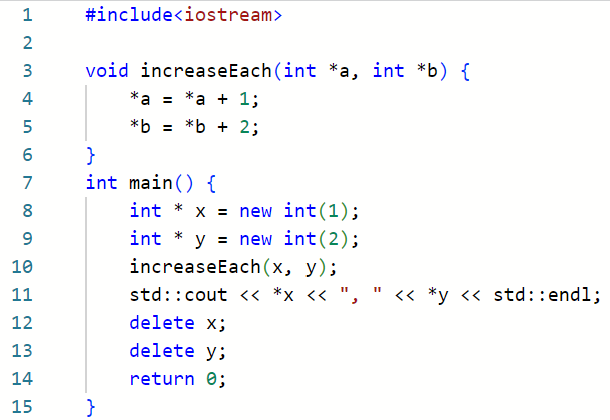
A.
B.
C.
D. The code results in a compile error.
E. The code results in a runtime error, or it has undefined behavior because
F. None of the above describes the execution of this code.
1, 2 sent to standard out. B.
2, 3 sent to standard out. C.
2, 4 sent to standard out. D. The code results in a compile error.
E. The code results in a runtime error, or it has undefined behavior because
a and b go out of scope. F. None of the above describes the execution of this code.
Question 20
What is the result of compiling and executing the following code?
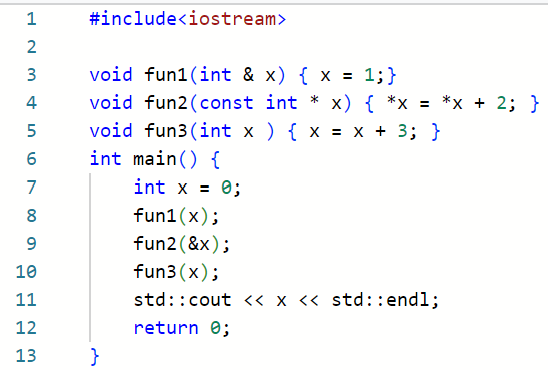
A.
B.
C.
D. This code does not compile.
E. None of these options is correct.
3 sent to standard out. B.
5 sent to standard out. C.
6 sent to standard out. D. This code does not compile.
E. None of these options is correct.
Question 21
There is a bug in the following code, also provided to you at https://godbolt.org/z/9xvr71roq
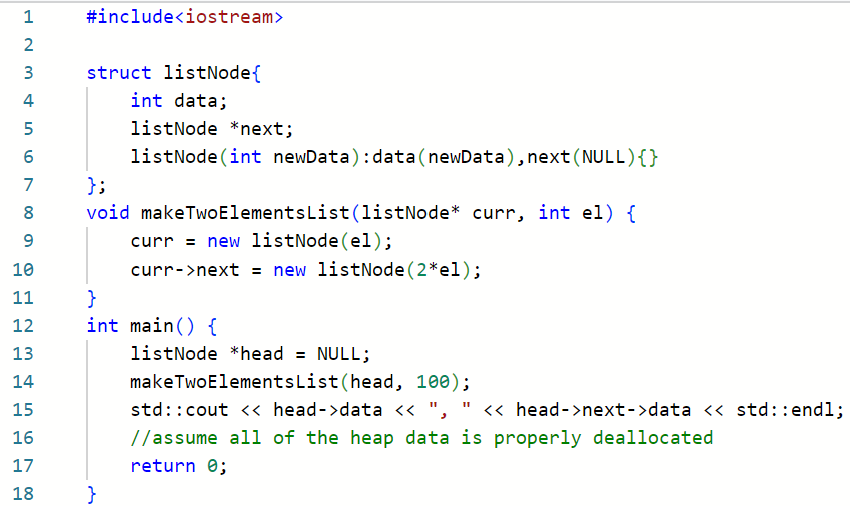
Identify the line containing a critical bug. Once fixed, the output will be
100, 200. What line is it?A. Line 6
B. Line 8
C. Line 10
D. Line 13
E. Line 15
F. None of the above.
B. Line 8
C. Line 10
D. Line 13
E. Line 15
F. None of the above.
8. Copy constructor, destructor, operator overload
Question 23
Choose one statement that is true about the result of compiling and executing the following code?
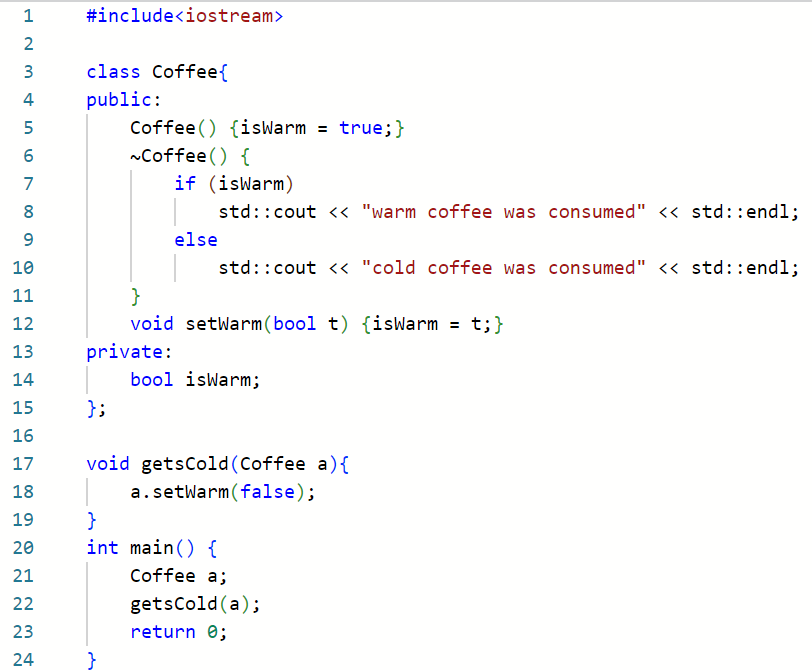
A. The string
B. The string
C. The string
D. The code results in a compile error.
E. The code results in a runtime error.
cold coffee was consumed is sent to standard out once. B. The string
cold coffee was consumed is sent to standard out twice. C. The string
cold coffee was consumed is not sent to standard out. D. The code results in a compile error.
E. The code results in a runtime error.
Question 24
Consider the following code:
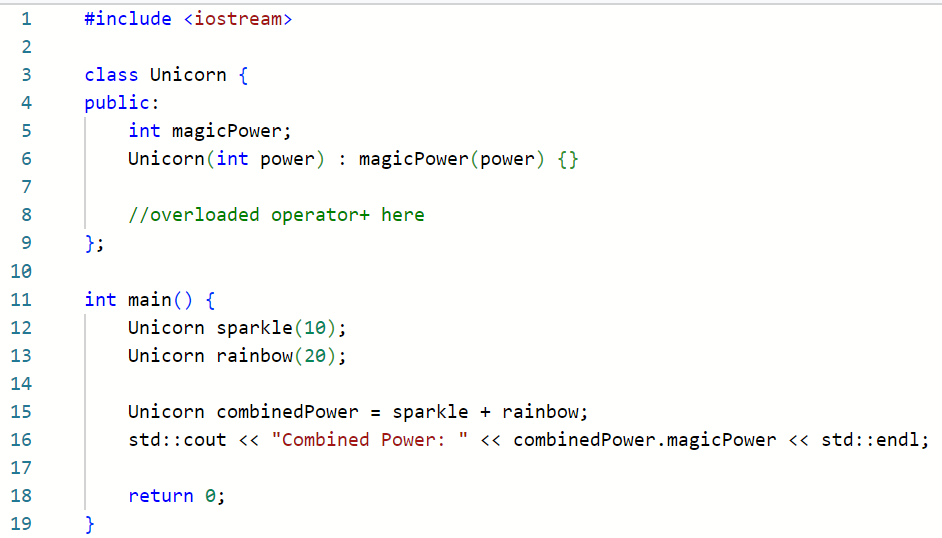
What is the correct way to define the function
operator + in the Unicorn class to allow two Unicorn objects to be added together, so that the above code compiles and runs with 30 sent to standard out?A.
B.
C.
D.
E.
Unicorn operator+(const Unicorn& other)B.
Unicorn operator+(const Unicorn* other)C.
Unicorn& operator+(Unicorn& other)D.
Unicorn& operator+(Unicorn other)E.
Unicorn* operator+(Unicorn* other)9. Inheritance, virtual functions, abstract classes
Question 25
Assume that all of the constructors, destructors and member functions are well implemented and result in a code with no compile or runtime errors.
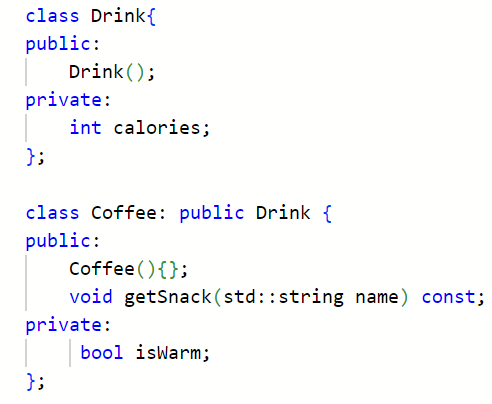
Which one of the following statements is true?
A. Both
B. Both
C. Both
D.
E. More than one statement above is true.
Drink() constructor and getSnack can make the assignment isWarm = true. B. Both
Drink() and Coffee() constructors can make the assignment calories = 200. C. Both
Coffee() constructor and getSnack can make the assignment isWarm = true, but Drink() constructor cannot. D.
Drink() constructor can make the assignment calories = 200, but Coffee() constructor cannot. E. More than one statement above is true.
Question 26
Which one is true about the result of compiling and executing the following code?
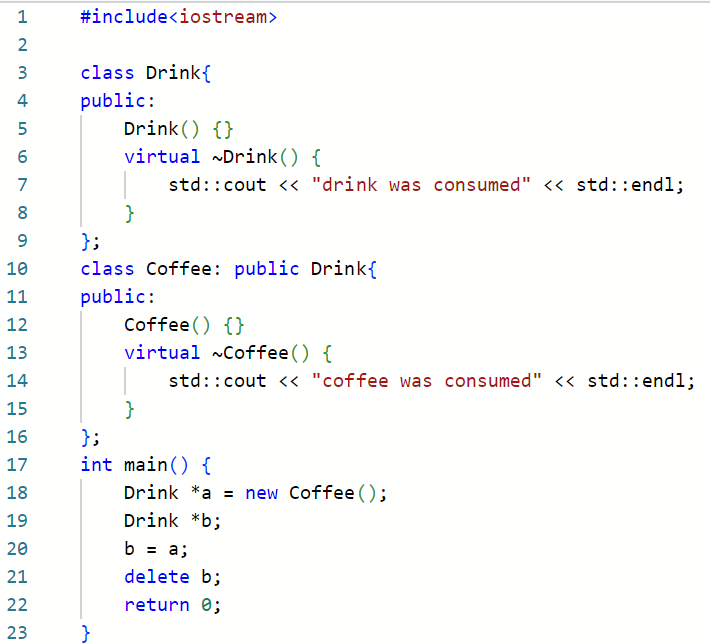
A. The string
B. The string
C. The string
D. The code results in a compile error.
E. The code results in a runtime error.
coffee was consumed sent to standard out once. B. The string
coffee was consumed sent to standard out twice. C. The string
coffee was consumed is not sent to standard out. D. The code results in a compile error.
E. The code results in a runtime error.
Question 27
Consider the following code involving two classes,
Unicorn and BabyUnicorn, in which BabyUnicorn inherits from Unicorn. The Unicorn class has a constructor that requires an integer argument, whereas BabyUnicorn has a no-argument constructor.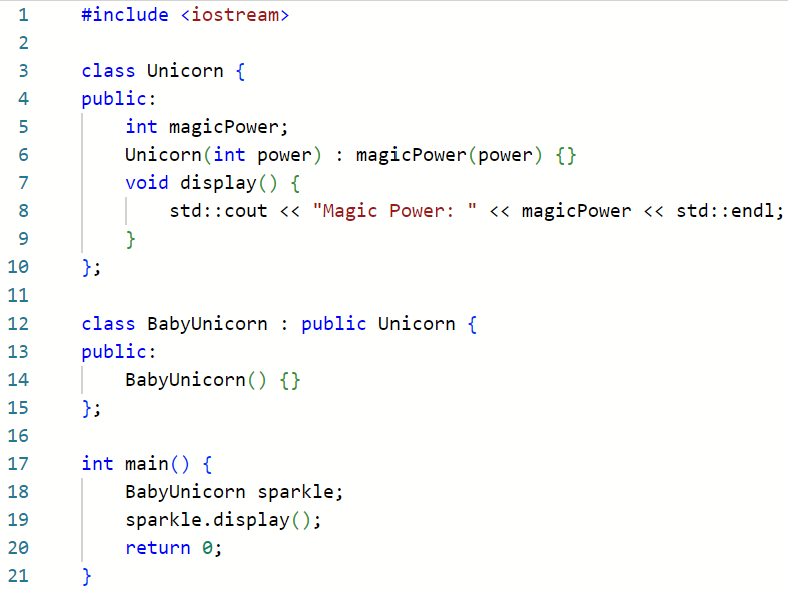
There is a problem with the code, which one is it?
A. The code compiles and outputs
B. The code results in a compile error due to the lack of an appropriate no-argument constructor in the
C. The code results in a runtime error because the
D. The code compiles successfully, but does not run due to a segmentation fault.
E. None of the above describes the problem.
Magic Power: 0B. The code results in a compile error due to the lack of an appropriate no-argument constructor in the
Unicorn class.C. The code results in a runtime error because the
BabyUnicorn class does not initialize its parent class properly.D. The code compiles successfully, but does not run due to a segmentation fault.
E. None of the above describes the problem.
Question 28
Consider the pure virtual class
Holiday, and Vappu class inherited from Holiday.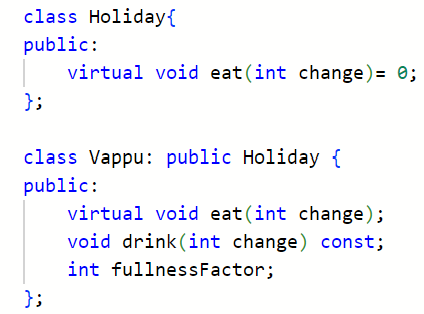
Which of the statements is true about the assignment
fullnessFactor += change;? A. Both
B. Neither
C.
D.
E. The answer to this question cannot be determined from the given code.
Vappu::eat and Vappu::drink can make the assignment. B. Neither
Vappu::eat nor Vappu::drink can make the assignment. C.
Vappu::eat can make the assignment, but Vappu::drink cannot. D.
Vappu::drink can make the assignment, but Vappu::eat cannot. E. The answer to this question cannot be determined from the given code.
10. Templates, generic programming
Question 29
What is the result of compiling and executing the following code?
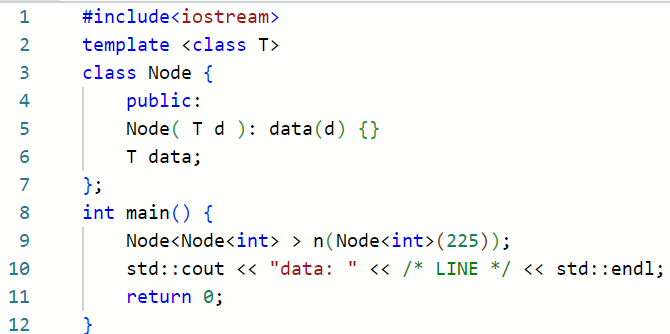
Which of the following should replace
/* LINE */ to have the code compile and run with data: 225 sent to standard out? A.
B.
C.
D.
E. None of the above.
n.dataB.
n.data.dataC.
n.data->data D.
n->data.dataE. None of the above.
Question 30
Consider the following templated function definition:
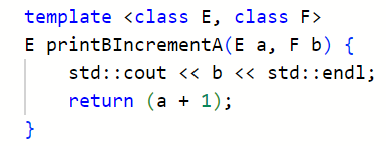
Which of the following statements in the client
main function will give a compiler error? A.
B.
C.
D. Exactly two of the above statements result in a compiler error.
E. All three of the above statements compile with no error.
int b = printBIncrementA<int, std::string>(100, "my grade");B.
int b = printBIncrementA<int, int>(4, 8);C.
int b = printBIncrementA<int, double>(4, 4.1);D. Exactly two of the above statements result in a compiler error.
E. All three of the above statements compile with no error.
11. Linked memory, recursion, dictionaries, hash tables
Question 31
There is a bug in the following code:
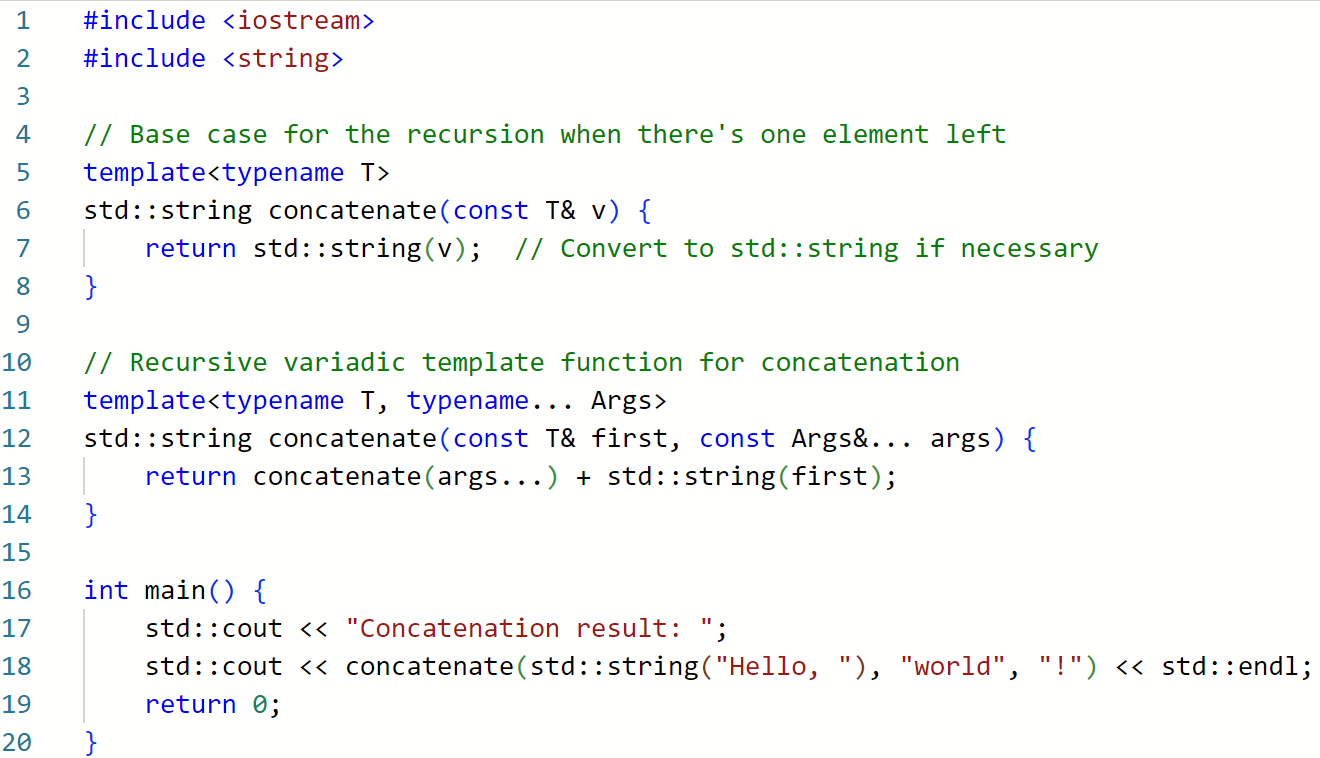
Strings are being concatenated in reverse, resulting in
!worldHello, output. Which solution would correctly output Hello, world!?A. Change line 13 to
return concatenate(args...);B. Change line 13 to
return std::string(first) + concatenate(args...)C. Change line 13 to
return concatenate(first, args...);D. Change line 13 to
return std::string(first) + concatenate(args...) + std::string(first);E. Change line 13 to
return std::string(first) + concatenate(args...) + std::string(args...);12. STL, iterators
13. Payroll Mock Code (25 points)
You have been provided with a codebase that defines an
Employee class capable of handling employee details including their name, hourly rate, hours worked, and a unique emoticon representation based on their wage. The class structure and main function are already set up but lack several implementations which are outlined in the form of TODO comments. In the following five problems your task will be to implement the missing functionalities.You can access the codebase here: https://godbolt.org/z/TfsbE6cK3.
You are welcome to modify the code in any way you like to answer the questions below. However, you may not modify any of the existing code; additions are only allowed in the specified sections to fulfill the TODO requirements. Upon successful compilation and execution of your modified code, the program should produce the following output on standard out:
Elmo: $675.00
Displaying emoji:
 . . .
. o o  .
.  __  .
 . . .
Zoe: $1900.00
Displaying emoji:
\|/ ____ \|/
 @~/ ,. \~@
/_( \__/ )_\
   \__U_/
Bubbles: $940.00
Displaying emoji:
 . . .
. o o  .
.  __  .
 . . .
Question 33
Which one of the following is the correct implementation of the function
setName for the Employee class?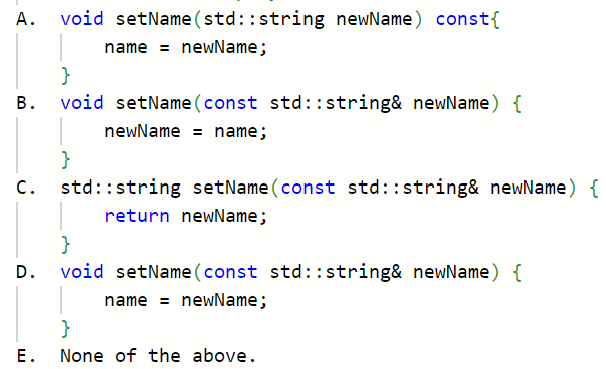
Question 34
Which of the following is the proper implementation of the copy constructor for the
Employee class that includes a nested Emoticon class?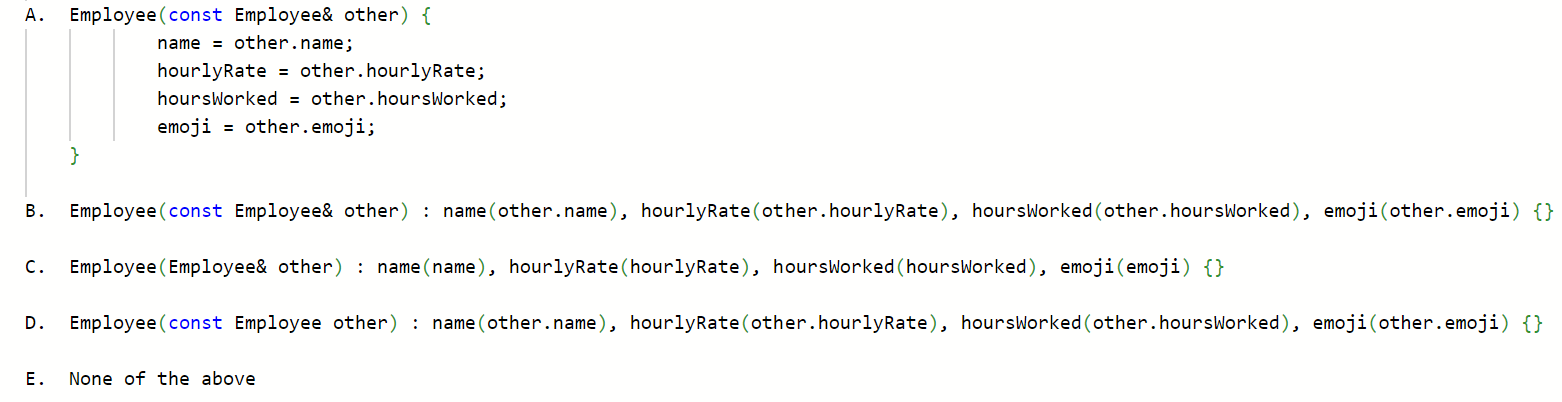
Question 36
In the
main function, implement a loop that iterates through the Employees vector, displaying each employee's details on std::cout.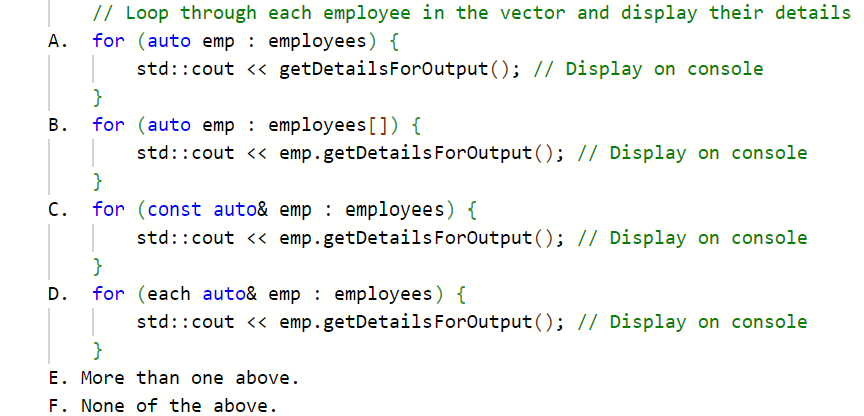
14. Course Feedback (Guaranteed Points)
Note: Make sure you go to the official Peppi feedback for IC00AQ92-3001 - C++ Programming to leave your comments there. This will greatly help the future development of this course.
Anna palautetta
Kommentteja materiaalista?