Assessment
Course Assessment
Introduction to the computer systems (5 ECTS, 521287A)
Students must meet the minimum requirements to pass BOTH Module 1 and Module 2 separately.
The total number of points students can get adding points from Module 1 and Module 2 is 0 - 60. If students exceed the 60 points, a maximum of 60 points is considered.
| Points Range | Grade |
| < 31 | 0 |
| 31 - 36 | 1 |
| 37 - 42 | 2 |
| 43 - 48 | 3 |
| 49 - 54 | 4 |
| 55 - 60 | 5 |
Computer Systems (8 ECTS, 521286A)
Students must meet the minimum requirements to pass ALL Module 1, Module 2, Module 3 and Module 4 separatetly.
The total number of points students can get adding points from the 4 modules is 0 - 100. If students exceed 100 points a maximum of 100 points is considered.
| Points Range | Grade |
| < 51 | 0 |
| 51 - 60 | 1 |
| 61 - 70 | 2 |
| 71 - 80 | 3 |
| 81 - 90 | 4 |
| 91 - 100 | 5 |
Module Assessment
Module 1
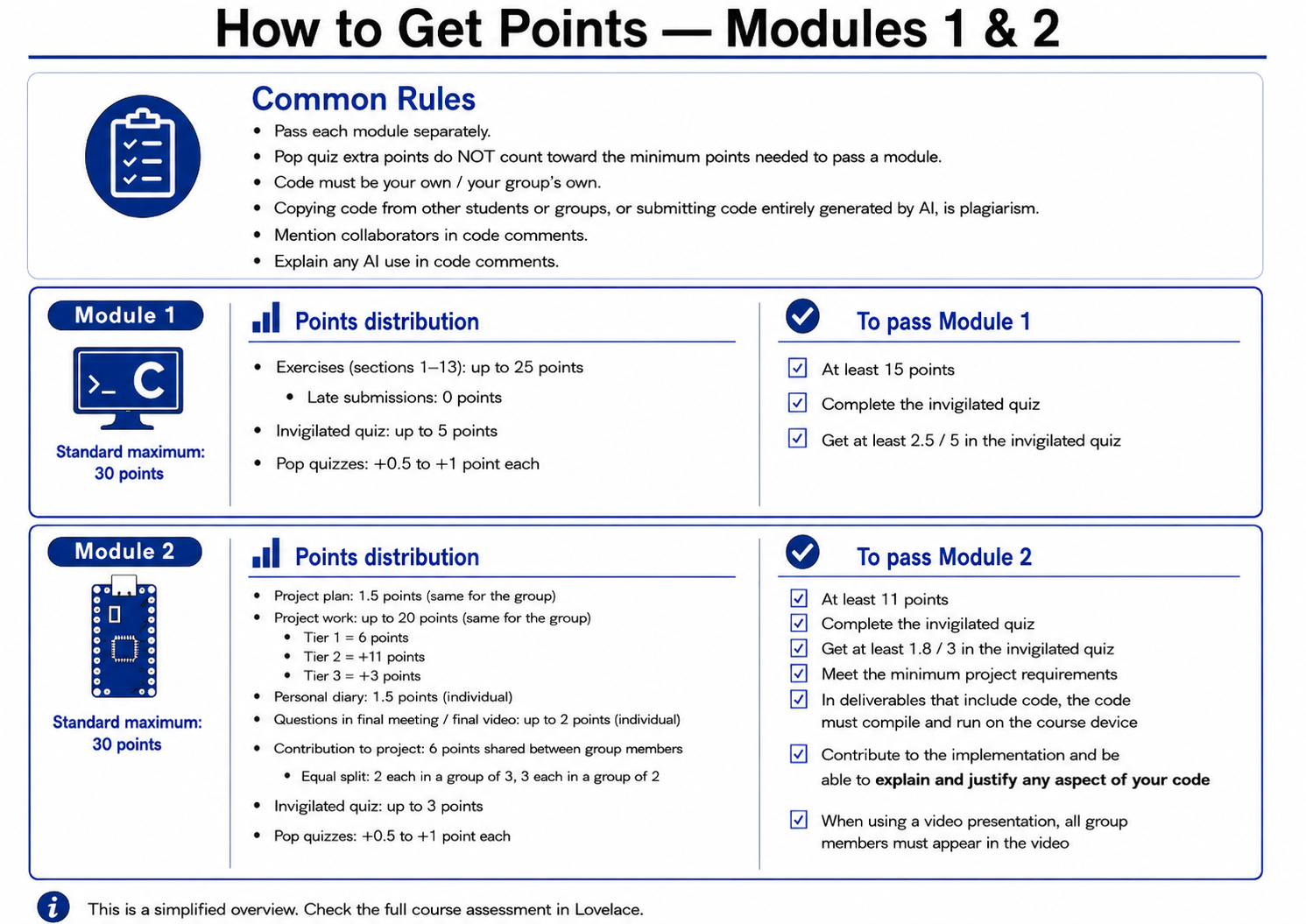
Students are evaluated using the exercises from sections 1-13 of Module 1 and an invigilated quiz.
The standard maximum number of points in this module is 30. However, an individual student's total may exceed 30 through extra points from pop quizes.
POINTS DISTRIBUTION:
- From the exercises students can get a maximum of 25 points. Each exercise is automatically scored based on difficulty: 0.5-3p
- ATTENTION: The lecture material include exercises that do not provide any points.
- ATTENTION: Students returning exercises after the given deadline do not get any points from that exercise.
- From the -- WARNING: BROKEN LINK -- students get a maximum of 5 points
- Each pop quiz can give students 0.5 to 1 extra point. Extra points from pop quizes do not count towards the minimum number of points required to pass the module.
Conditions to pass this module
- Student gets a minimum of 15 points.
- Student has completed the invigilated quiz
- Student gets 50% of points in the invigilated quiz (2.5 points / 5 points)
- Code is generated by the own student. Students cannot copy code from other students or use code entirely generated by AI. This is considered plagiarism.
- Similar code would be flagged as potentially copied.
- Students that have collaborated should be mentioned in the code comments or similar.
- Students should comment on how AI is used in the code comments. The full code cannot be generated by AI.
Module 2
Students are evaluated using the different deliverables for the embedded programming project, an invigilated quiz and a final meeting presentation OR a video where students present their final project.
The standard maximum number of points in this module is 30. However, an individual student's total may exceed 30 depending on how the contribution points are distributed among group members and through extra points from pop quizes. More info of individual deliverables will be available embedded programming project (AVAILABLE BEFORE FINAL PROJECT PRESENTATION)
POINTS DISTRIBUTION:
- Project plan: Max 1.5 points. Students in the same group receive the same number of points.
- Project work: Max 20 points. Students in the same group receive the same number of points.
- Students can choose among the different tiers depending on the number of points the group aims for.
- Each deliverable must meet a minimum set of requirements in order to be accepted.
- Tier 1: A correct implementation gives 6 points.
- Tier 2: Can add up to 11 more points to the project work score. Only possible if the minimum requirements for Tier 1 are met.
- Tier 3: Can add up to 3 more points to the project work score. Only possible if the minimum requirements for Tier 2 are met.
- Personal diary: Max 1.5 points. This is a personal work and each student is evaluated based on their personal deliverable.
- Questions answered during final meeting / questions answered during final video: Max 2 points. Each Student gets a different number of points.
- Students can choose between final meeting or the video presentation depending on the project deliverables they commit to send. The selection affects the maximum number of points: fewer points are available for the video option than for the final meeting.
- Students who are not able to answer basic questions about the project work during the meeting CANNOT PASS THIS MODULE
- Contribution to the project: 6 points to be distributed among group members. Decision agreed with students during final meeting or communicated along with the video deliverable.
- If the 6 contribution points are distributed equally, each student receives 2 points in a group of three and 3 points in a group of two.
- Course staff may modify the distribution of points if it is clearly unfair, but will generally follow the students’ suggestion.
- Invigilated quiz about theoretical/practical aspects of the implementation: Max 3 points.
- Each pop quiz can give students 0.5 to 1 extra point. Extra points from pop quizes do not count towards the minimum number of points required to pass the module.
NOTE: More detailed assessment criteria in each deliverable return box.
Conditions to pass this module
- Student gets a minimum of 11 points.
- Student has completed the invigilated quiz
- Student gets 60% of the points in the invigilated quiz (1.8 points / 3 points)
- Project deliverable meets the minimum set of requirements necessary to be accepted (see more details in project instructions)
- In all deliverables that include code, the code must at least compile and run on the course device.
- Code must be written by the group itself. Students cannot copy code from other groups or use code entirely generated by AI. This is considered plagiarism.
- Similar code may be flagged as potentially copied.
- Groups that have collaborated should be mentioned in the code comments or similar.
- Groups should comment on how AI is used in the code comments. The full code cannot be generated by AI.
- Student has contributed to the project implementation somehow (and should be able to describe which piece of code they have written)
- Students who only take part in design and/or testing of the project cannot pass this module.
- Students are able to answer basic qustions related to the project work (code implementation, explain programming decisions ...)
- If one student in the group is not able to answer any of these basic questions they automatically cannot pass this module.
- In the case of a video presentation, ALL students in the group should be part of the video shooting, and be visible in the video.
Module 3
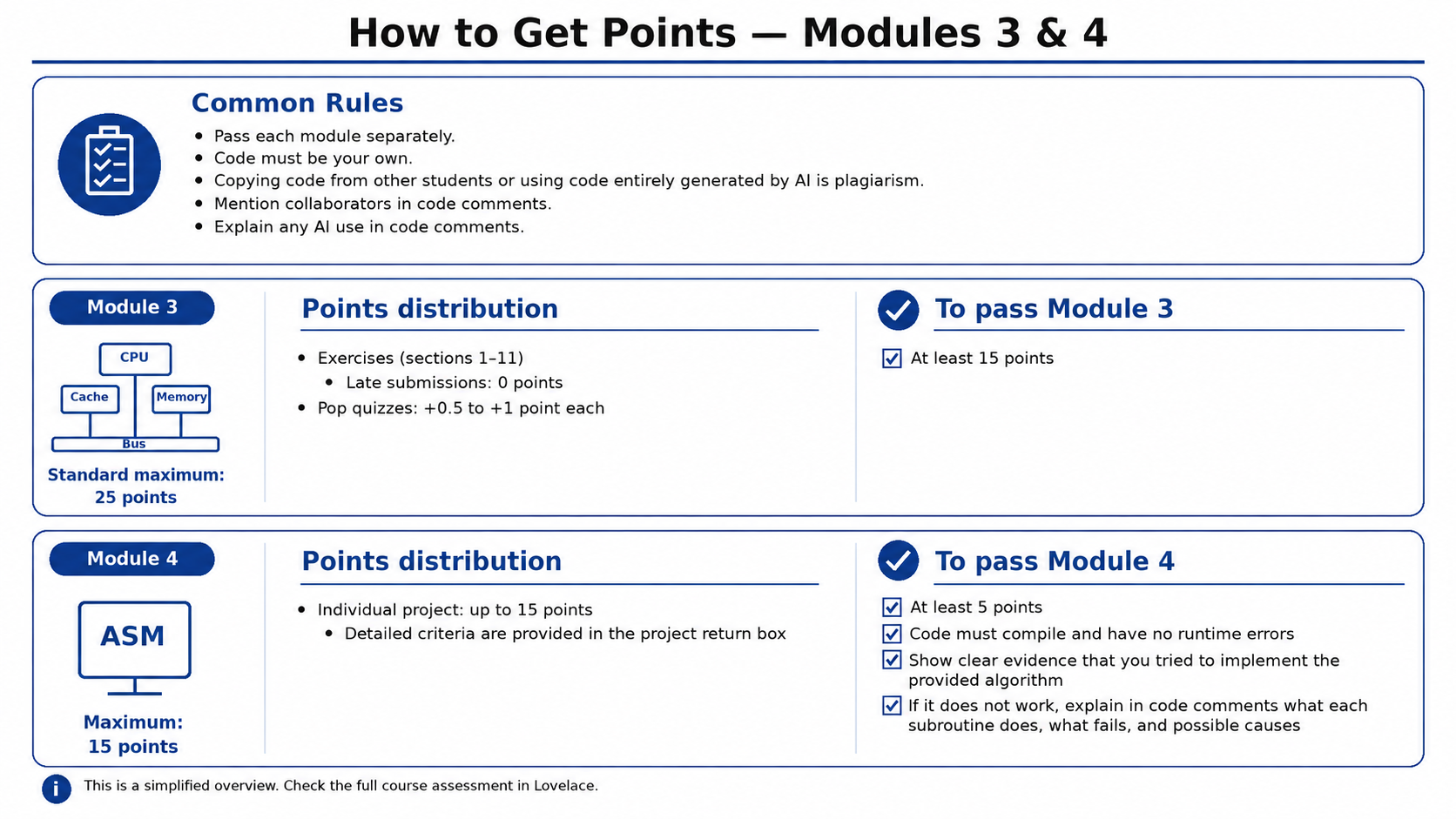
Students are evaluated using the exercises from sections 1-11 of Module 3
The standard maximum number of points Student gets in this module is 25. However, an individual student's total may exceed 25 through extra points from pop quizes.
POINTS DISTRIBUTION:
- Each exercise is automatically scored based on difficulty: 0.5-3p
- ATTENTION: The lecture material include exercises that do not provide any points.
- ATTENTION: Students returning exercises after the given deadline do not get any points from that exercise.
- Each pop quiz can give students 0.5 to 1 extra point. Extra points from pop quizes do not count towards the minimum number of points required to pass the module.
Conditions to pass this module
- Student gets a minimum of 15 points.
- Code is generated by the own student. Students cannot copy code from other students or use code entirely generated by AI. This is considered plagiarism.
- Similar code would be flagged as potentially copied.
- Students that have collaborated should be mentioned in the code comments or similar.
- Students should comment on how AI is used in the code comments. The full code cannot be generated by AI.
Module 4
Students are evaluated through an individual project work.
Maximum number of points Student gets in this module is 15.
See the project return box for more detailed criteria on how 15 points are distributed.
Conditions to pass this module
- Student gets a minimum of 5 points.
- Code should compile and not have runtime errors.
- There should be clear proof that students tried to implement the provided algorithm. If it is not working add comments indicating what each subroutine is doing, what is failing and which are the possible causes.
- Code is generated by the own student. Students cannot copy code from other groups or use code entirely generated by AI. This is considered plagiarism.
- Similar code would be flagged as potentially copied.
- Students that have collaborated should be mentioned in the code comments or similar.
- Students should comment on how AI is used in the code comments. The full code cannot be generated by AI.
Assessment summary